
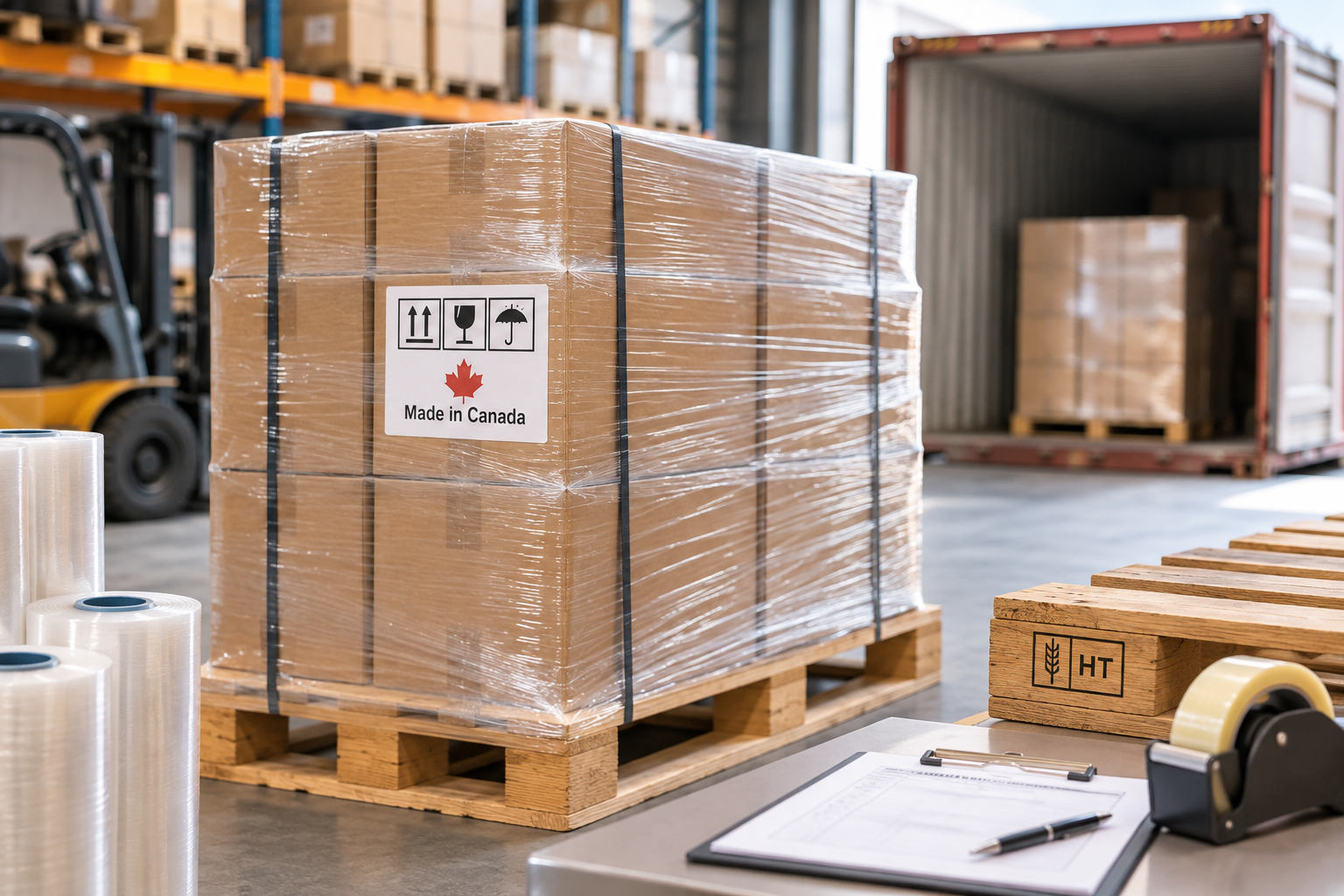
What stretch wrap alone does not protect against
Stretch wrap is built to hold boxes tight to a pallet through stretch and cling, and it does that job well. What it does not do is add rigidity to the load itself. A pallet stacked several layers high, handled by forklift, and stacked under or next to other pallets in a trailer still has exposed vertical corners that take the full force of any crushing pressure, whether that comes from another pallet leaning against it, a stack shifting in transit, or simple column stacking weight in a warehouse. Stretch wrap holds the boxes in place while that pressure does its damage, it does not stop the damage from happening in the first place.
What corner boards and edge protectors actually do
A corner board, sometimes called an edge protector, is an L-shaped strip of heavy board run vertically along each corner of a palletized load, under the stretch wrap. It spreads crushing force across the length of the board instead of letting it concentrate on the corner of a single box, which is almost always where freight damage shows up first. Corner boards come in different thicknesses and lengths, and the right choice depends on load weight and height, a tall, heavy load stacked several layers high needs a heavier board than a short, light pallet that is mostly being protected against incidental handling bumps. For most GTA businesses shipping standard freight pallets, a mid-weight corner board run the full height of the load, wrapped in place with the stretch wrap, covers the majority of cases.
Why strapping needs edge protection, not just stretch wrap
Poly woven strapping is a different product from stretch wrap and does a different job. Where stretch wrap holds boxes against the pallet through cling and tension spread evenly across the load, a strap is pulled tight at a few specific points and holds through sheer tension at those points. That tension is exactly what makes strapping effective for keeping a tall, top-heavy, or irregular load from shifting on a forklift, but it is also what causes a strap to cut into unprotected corrugated at the edge, crushing or slicing into the top layer of boxes exactly where the strap crosses. A corner board or a flat edge protector placed under the strap at every point it crosses an edge solves this, spreading the strap's tension across the board instead of letting it bite into the carton. Strapping without edge protection on a corrugated load is a common and avoidable source of damage claims, not a necessary cost of using straps at all.
When stretch wrap alone is enough
A single local GTA delivery, handled once from your dock to the destination with no extended storage or multiple carrier handoffs in between, generally does not need corner boards or strapping on top of a properly applied stretch wrap job. The load is not sitting in a trailer stacked against other freight, is not going through multiple forklift handoffs, and is not in transit long enough for incidental shifting to compound into real damage. Adding protection the shipment does not need is just added cost and added time at the packing station for no real reduction in damage risk.
When to add corner boards and strapping
Freight or LTL shipments handled by more than one carrier or passing through a freight terminal before reaching the destination benefit from corner boards at minimum, since every additional handoff is another chance for a pallet to get bumped, leaned on, or stacked against.
Tall or top-heavy loads, especially anything stacked higher than the pallet's base footprint can comfortably support on its own, are a strong candidate for strapping in addition to stretch wrap, with corner boards underneath every strap crossing.
Long-haul shipments and anything spending more than a day or two in transit carry more cumulative handling risk than a short local run, which is where the added cost of corner boards and strapping starts to pay for itself in avoided damage claims.
Warehouse racking and long-term storage situations benefit from corner boards even with no transit involved at all, since column stacking pressure in a rack over weeks or months crushes unprotected corners the same way freight handling does, just more slowly.
Where GTA businesses skip this and pay for it later
Shipping a tall, heavy freight pallet with stretch wrap only and no corner boards, then filing a damage claim for crushed corners that a few dollars of board would have prevented.
Strapping a load directly against the corrugated with no edge protection, and finding the top layer of boxes cut or crushed exactly where the strap crossed the load.
Treating every outbound pallet the same regardless of whether it is a short local delivery or a multi-day freight shipment, which means either over-protecting low-risk local loads or under-protecting the freight shipments that actually need it.
Corner board and strapping checklist
1. Use stretch wrap alone for single local deliveries with no extended transit or multiple handoffs
2. Add corner boards under the stretch wrap for any freight or LTL shipment passing through more than one handoff
3. Match corner board thickness and length to load weight and height rather than using one size for every pallet
4. Add poly strapping for tall, top-heavy, or irregular loads that need extra stability beyond stretch wrap
5. Always place a corner board or edge protector under every point a strap crosses the load, never strap directly against unprotected corrugated
6. Use corner boards in warehouse racking for long-term storage, even when the pallet is not going anywhere
What to do next
Pull your recent freight damage claims and look specifically at where the damage occurred on the pallet, crushed corners and cut or compressed top layers point to a stretch-wrap-only load that needed corner boards or properly protected strapping instead. If the damage is clustered on specific freight lanes or specific customers, that is exactly where the extra few dollars of protection per pallet pays for itself fastest.
Packaging Shop stocks corner boards, edge protectors, stretch wrap, and poly strapping for GTA businesses shipping freight pallets and storing palletized inventory long term.