
Why food and beverage shipments are not a regular parcel problem
A box of hardware or apparel sits in a truck indefinitely without changing. A jar of sauce, a case of beer, or a box of baked goods is a different kind of cargo, it can leak, ferment, sweat, or go stale while it is in transit, and none of that shows up until the box is opened at the other end. The packaging has to do three jobs at once that a normal shipping box only ever has to do one of: contain a potential liquid failure, hold a temperature range for a limited window, and protect a product that may already be close to the end of its useful shelf life. Treat these as three separate checks on every order, not one general packaging decision.
Containing liquids before they ever reach the outer box
The outer corrugated box is the last line of defence, not the first. Build containment in from the inside out:
1. Individually bag or wrap any bottle, jar, or container that could leak, even if you trust the lid or cap, handling in transit loosens seals that held fine sitting on a shelf.
2. Use absorbent pads or packing paper around anything holding liquid, so a small leak is contained inside the box rather than soaking through the corrugated wall.
3. Line the inside of the box with a poly liner for anything shipping sauces, oils, honey, or similar products, this is the difference between a slow seep and a box that arrives intact even if one container fails.
4. Tape every seam on the outer box, top and bottom, rather than a single strip down the centre, a liquid failure finds the weakest seam first.
None of this replaces a well-sealed product. It is there for the one unit in a few hundred that fails anyway.
Keeping cold chain items cold long enough, without over-packing everything
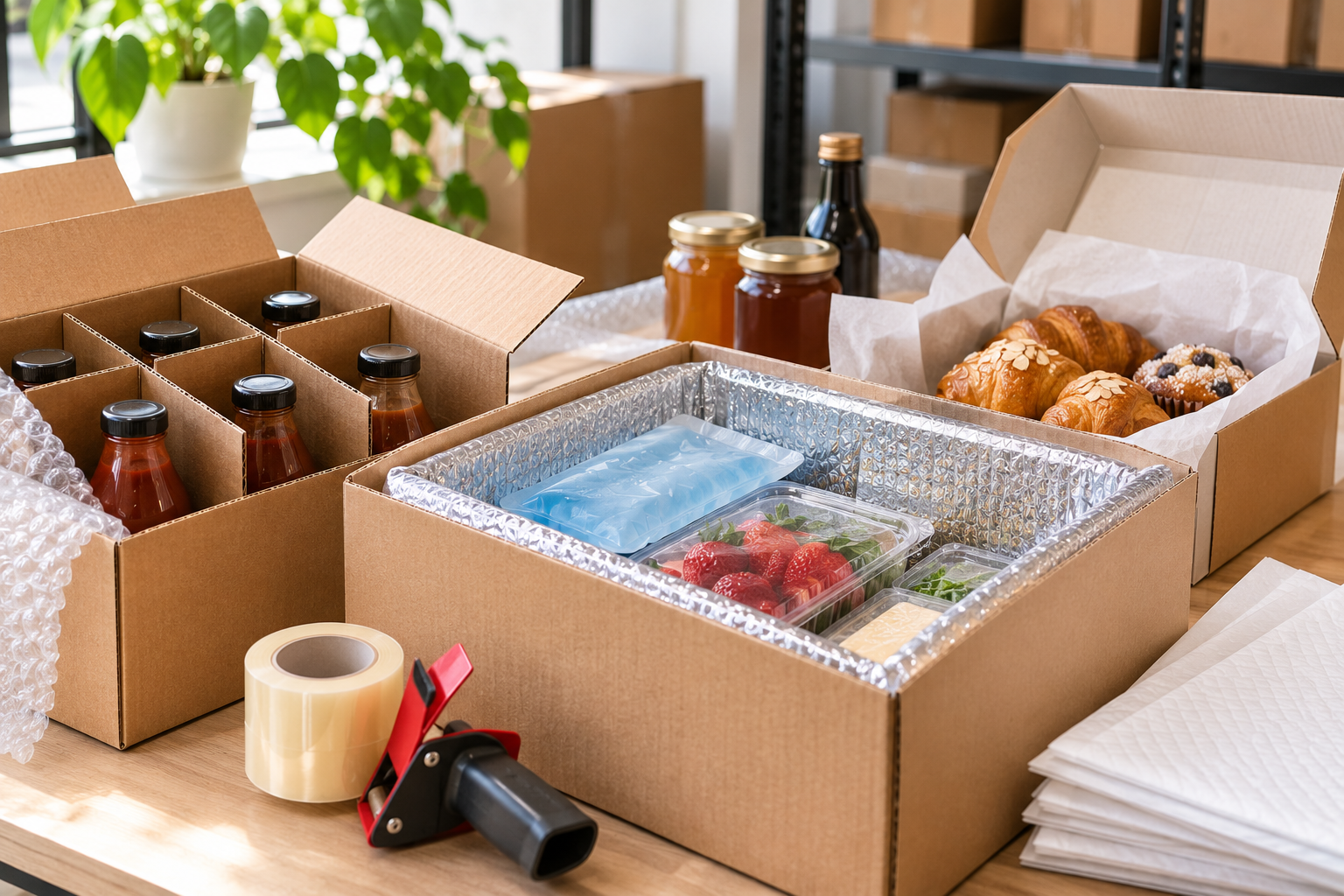
Most GTA food businesses do not need true cold chain packaging, they need to hold a temperature range for a few hours to a day, which is a much smaller problem. An insulated box liner or a foam box-in-box insert, combined with a gel pack or ice pack placed on top of the product rather than underneath, generally covers a local or regional delivery window, since cold air sinks and a top-placed pack keeps the whole box cooler for longer than one at the bottom. Reserve heavier insulation and multiple ice packs for anything shipping further than a same-day or next-day local delivery can cover.
The bigger failure point is usually timing, not insulation. A perfectly insulated box that sits packed on a counter for three hours before pickup has already lost most of the benefit of the insulation before the courier even arrives. Pack cold and frozen orders as close to pickup time as your kitchen workflow allows, not at the start of a packing run.
Protecting bottles and jars with dividers, not just packing material
Loose bottles or jars wrapped individually in paper still move around inside a box and chip or crack against each other during transit. A corrugated cell divider or partition insert, sized to hold each bottle or jar in its own compartment, stops that movement entirely and is the standard approach for breweries, wineries, and specialty food producers shipping glass. It costs more per shipment than loose packing material, but for a product where a single breakage means a refund, a damage claim, and a bad review, the divider usually pays for itself on the first prevented breakage.
Box sizing and handling for baked goods and fresh produce
Baked goods and fresh produce fail differently than liquids, they get crushed, bruised, or shifted rather than leaked. The most common mistake is sizing the box for the product's weight rather than its fragility, a box that could easily hold a case of hardware at that weight may still crush a delicate pastry if there is any room for it to shift during handling. Size these boxes tightly enough that the product cannot move, use a rigid insert or divider for anything stacked in layers, and avoid oversized boxes that feel protective but actually give the contents more room to collide with each other.
Matching packaging effort to how far the order is actually travelling
Not every order needs the full treatment. A same-day local GTA delivery of a cold item has a much smaller window of risk than a shipment going out of province, and packaging it like a multi-day cross-country shipment wastes money and packaging material on every single order. Set two or three packaging tiers based on distance and transit time, light containment and no insulation for same-day local delivery, standard insulation for next-day regional, and full insulation with extra ice pack capacity for anything travelling more than a day. Match the order to the tier automatically rather than deciding fresh each time a box goes out.
Food and beverage shipping checklist
1. Individually bag or wrap anything that could leak, even sealed containers you trust
2. Add a poly liner and absorbent pads for sauces, oils, and other liquid products
3. Place cold packs on top of the product, not underneath, and pack as close to pickup time as possible
4. Use cell dividers for bottles and jars rather than loose packing material
5. Size boxes tightly around fragile baked goods and produce so nothing can shift
6. Set two or three packaging tiers based on how far and how long the order is travelling
7. Tape every seam on the outer box, top and bottom, on anything carrying liquid risk
What to do next
Pull your last month of shipping issues, leaks, breakage, spoilage complaints, and sort them by product type rather than treating them as one general packaging problem. Most GTA food and beverage businesses find the damage clusters around one or two product categories, bottled items or anything cold, rather than being spread evenly across everything they ship. Fix the packaging for that category first.