
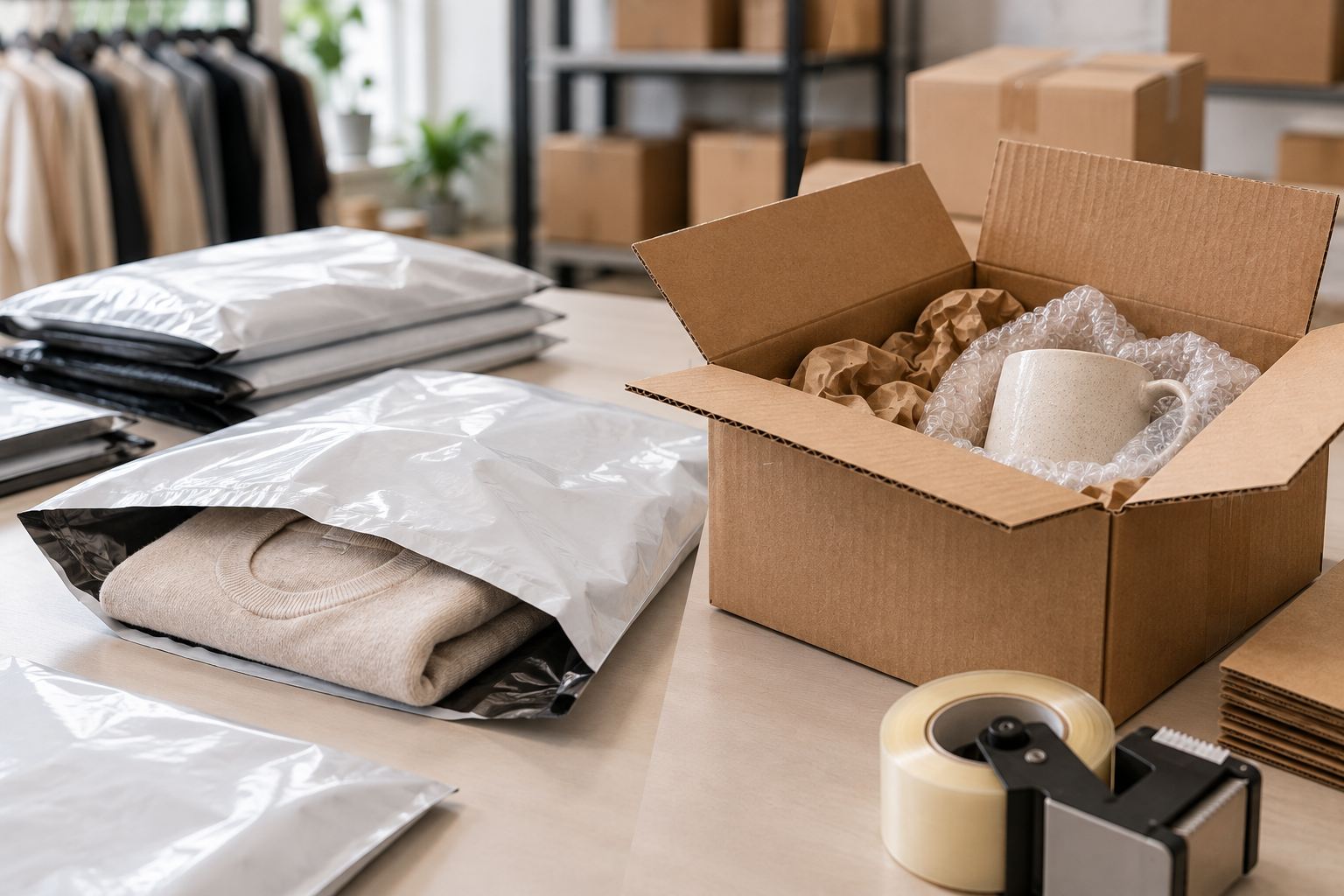
What a poly mailer is actually good for
A poly mailer is a lightweight polyethylene film pouch, usually self-sealing with a peel-and-stick strip, sometimes with a thin layer of bubble lining for light cushioning. It has no rigid structure of its own. That is its main advantage and its main limit at the same time.
Mailers work well for soft goods that can fold or compress without damage: apparel, linens and home textiles, bags, soft accessories, and lightweight paper goods that are not easily crushed. They are a poor fit for anything with corners, anything that needs to hold its shape, anything fragile, or anything heavy relative to its size.
The real cost lever is size, not material
Couriers bill a parcel at whichever is higher, its actual weight or its dimensional weight, a volume-based calculation tied to the package's outer dimensions. A rigid box sized for a folded sweater still has to account for the box's square corners even once the sweater is folded down inside it, so you are often paying to ship a cube of mostly empty space.
A mailer has no fixed shape, so it compresses down to roughly the footprint of the product itself. For soft, irregularly shaped goods this regularly drops a shipment into a smaller size bracket than the equivalent box would, which is where the real savings show up, not in the per-unit cost of the mailer itself.
The flip side: this only works because the product can actually compress safely. The moment you are tempted to jam a semi-rigid item into a mailer just to save on dimensional weight, that is the signal to stay with a right-sized box instead.
When a mailer is the right call
- Apparel, soft accessories, linens and home textiles
- Lightweight, non-fragile fabric or paper goods that are not easily crushed
- Products that will not be damaged by folding, light compression, or being tossed around a courier sorting facility
- Single-item, direct-to-consumer parcel shipments, not palletized or warehouse-stored freight
When to stay with a corrugated box
- Anything with hard edges or a shape that needs to be preserved: electronics, housewares, packaged goods in rigid containers
- Anything fragile: glass, ceramics, anything in a jar or bottle
- Multi-item orders where products could shift and damage each other without a rigid container keeping them apart
- B2B shipments that get palletized, stacked, or stored before final delivery, since a mailer offers zero stacking strength
- Retail-ready or gift-style packaging where the unboxing experience is part of the brand, a mailer reads as cheaper, not lighter
Padded versus standard, and sizing still matters
A padded mailer with a light bubble lining buys you a bit of tolerance for minor bumps and is worth the small extra cost for anything with slight fragility, think jewelry, cosmetics in plastic packaging, or soft electronics accessories. Standard, unpadded poly is for goods that genuinely cannot be damaged by handling.
Sizing discipline does not disappear just because the format is flexible. An oversized mailer wastes material, looks sloppy on arrival, and leaves enough loose film that a product can shift to one end and get crushed in a corner that was never meant to take weight. Match the mailer size to the product the same way you would a box.
A simple way to sort your catalogue
Go through your product lines and tag each one as a box candidate or a mailer candidate using fragility and rigidity as the filter, not habit. If a line has shipped in boxes for years purely because that is what you started with, it is worth a second look.
Before switching a whole category, run a trial. Move one SKU to mailers, track your return and damage rate against the same SKU's history for a month, and confirm the numbers hold before you commit packaging budget to a wider switch.
Poly mailer vs box checklist
1. Confirm the product can fold or compress without damage, if there is any doubt, keep the box
2. Compare landed shipping cost in a mailer against your current box, including the dimensional weight difference, not just the unit price of the packaging
3. Choose padded mailers for anything with mild fragility tolerance, standard poly for the rest
4. Size the mailer to the product, an oversized mailer still wastes material and protection
5. Keep anything palletized, stacked, or warehouse-stored in corrugated, mailers offer no stacking strength
6. Trial a switch on one SKU for a month before converting a full product line
What to do next
Pull your last month of shipments and flag anything that is soft, non-fragile, and currently going out in a box purely out of habit. Those are your best early candidates for a mailer switch, and usually the fastest place to see a real shipping cost drop.
Packaging Shop stocks both poly mailers and a full range of corrugated sizes, so you can split your catalogue the right way instead of forcing everything into one format. Local delivery across the GTA, walk-in pickup at our North York location, or pickup-only at our Mississauga and Scarborough locations.