
How dimensional weight is actually calculated
Every major parcel carrier uses the same basic formula:
(Length x Width x Height) divided by a fixed divisor = dimensional weight
You measure the outside of the packed box, not the product, and you round up. The divisor varies by carrier and by whether you are working in inches and pounds or centimetres and kilograms. For most Canadian ground and express parcel services, the commonly used figures are 139 cubic inches per pound, or 5,000 cubic centimetres per kilogram. Some Canada Post services use a different cubing factor, so check your own contract rather than assuming one number covers everything.
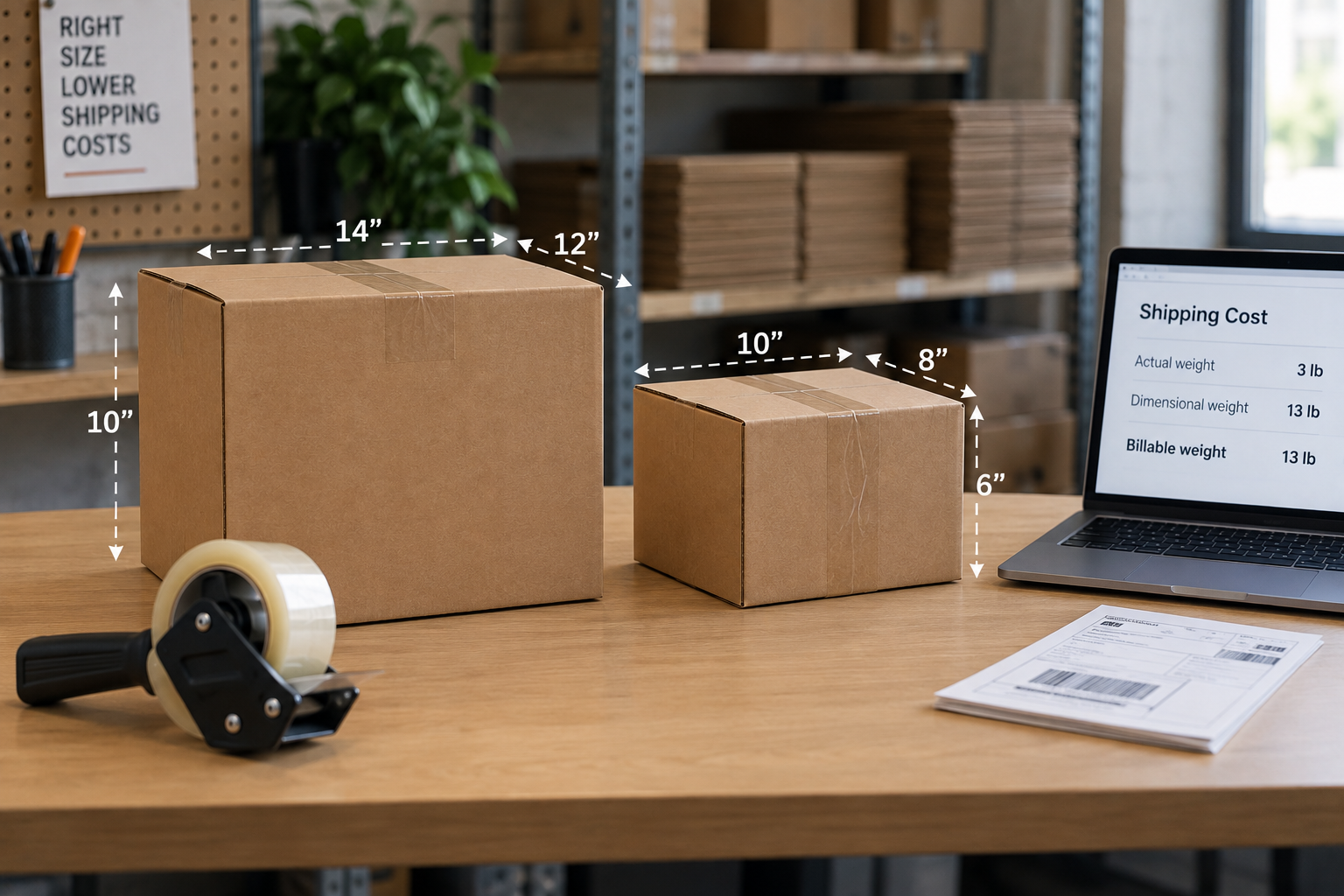
A worked example. You ship a 3 lb product in a 14 x 12 x 10 box:
- Volume: 14 x 12 x 10 = 1,680 cubic inches
- Dimensional weight: 1,680 divided by 139 = 12.1, rounded up to 13 lb
- Billable weight: 13 lb, not 3 lb
You just paid for 13 pounds of air. Now put the same product in a 10 x 8 x 6 box:
- Volume: 480 cubic inches
- Dimensional weight: 480 divided by 139 = 3.5, rounded up to 4 lb
- Billable weight: 4 lb
Same product, same courier, same destination. The only thing that changed was the box, and the billable weight dropped by roughly two thirds.
Why this hits GTA small businesses harder than they expect
Three patterns show up again and again in local shipping rooms:
1. The two-size problem. A lot of small operations run two or three box sizes for everything. That is easy on the stockroom and expensive on the invoice, because most orders end up in a box a size or two too big.
2. Void fill masking the issue. Once a box is too large, you add more paper or air pillows to stop the product moving. The fill costs money, adds a little weight, and does nothing at all to reduce the dimensional charge.
3. Zone pricing compounding it. Shipping across the GTA, the gap between actual and dimensional weight might cost you a dollar or two. Shipping to Vancouver or the Maritimes, that same gap gets multiplied by a longer zone rate.
None of this shows up as a line item called "oversized box." It shows up as a shipping cost per order that creeps upward while your product mix stays the same.
The one number worth calculating this week
Pick your five highest-volume orders. For each one, work out the dimensional weight of the box you currently use and compare it to the actual weight. The difference, multiplied by your monthly volume, is your over-boxing bill.
Most GTA businesses we talk to find that one or two SKUs account for the bulk of the waste, usually something small and light being shipped in a box chosen for convenience rather than fit. Fixing those two SKUs is often worth more than any negotiation on your carrier rate card.
How to bring the billable weight down
Shrink the box before you do anything else. With over a hundred standard corrugated sizes available, you can usually find something within an inch of your product instead of forcing it into a size you happen to have on the shelf. A single size step down on a high-runner SKU pays for itself inside a week of shipping.
Reduce height first. Height is the dimension most often wasted, because people pick a box by footprint and ignore how much headroom is left above the product. Height multiplies into the volume calculation exactly like length and width, so trimming two inches off a tall box removes more cubic inches than most people expect.
Do not let the box bulge. Carriers measure the box at its widest point, including any bulge from an over-packed load. A box packed past its comfortable fill line can measure a full inch larger than its stated size and get billed accordingly.
Flat-pack where the product allows. Apparel, textiles, printed materials, and anything soft-sided can often move in a much lower-profile box than the default cube most shops reach for.
Watch the seal. A poorly sealed box that has to be reinforced or re-boxed in transit can be re-measured and re-rated. Sealing properly with good quality tape on the first pass keeps the parcel at the dimensions you intended.
Where dimensional weight does not apply
It is worth knowing the limits so you do not over-correct:
- LTL freight and palletized shipments are priced on freight class and pallet dimensions, not parcel dimensional weight. Cube still matters there, but the calculation is different.
- Very dense products such as tools, hardware, liquids, and printed stock are usually billed on actual weight regardless of box size, because the real weight exceeds the dimensional weight. For those items, do not sacrifice protection to shave an inch. Use the strength grade the load actually needs.
- Some local courier and same-day services in the GTA price by parcel size bands rather than cubing. Check before you redesign your packing process around a rule that does not apply to your main lane.
Your dimensional weight checklist
Before your next box order:
1. Confirm the divisor your carrier actually uses, in the units you ship in
2. Calculate dimensional weight versus actual weight for your five highest-volume orders
3. Flag any SKU where dimensional weight is more than double the actual weight
4. Order a closer-fitting size for those SKUs, starting by cutting height
5. Re-check after a month of shipping, the savings should show on the invoice, not just on paper
Dimensional weight is the rare packaging problem where the fix is cheap and the payback is immediate. You are not buying anything extra, you are buying something smaller.