
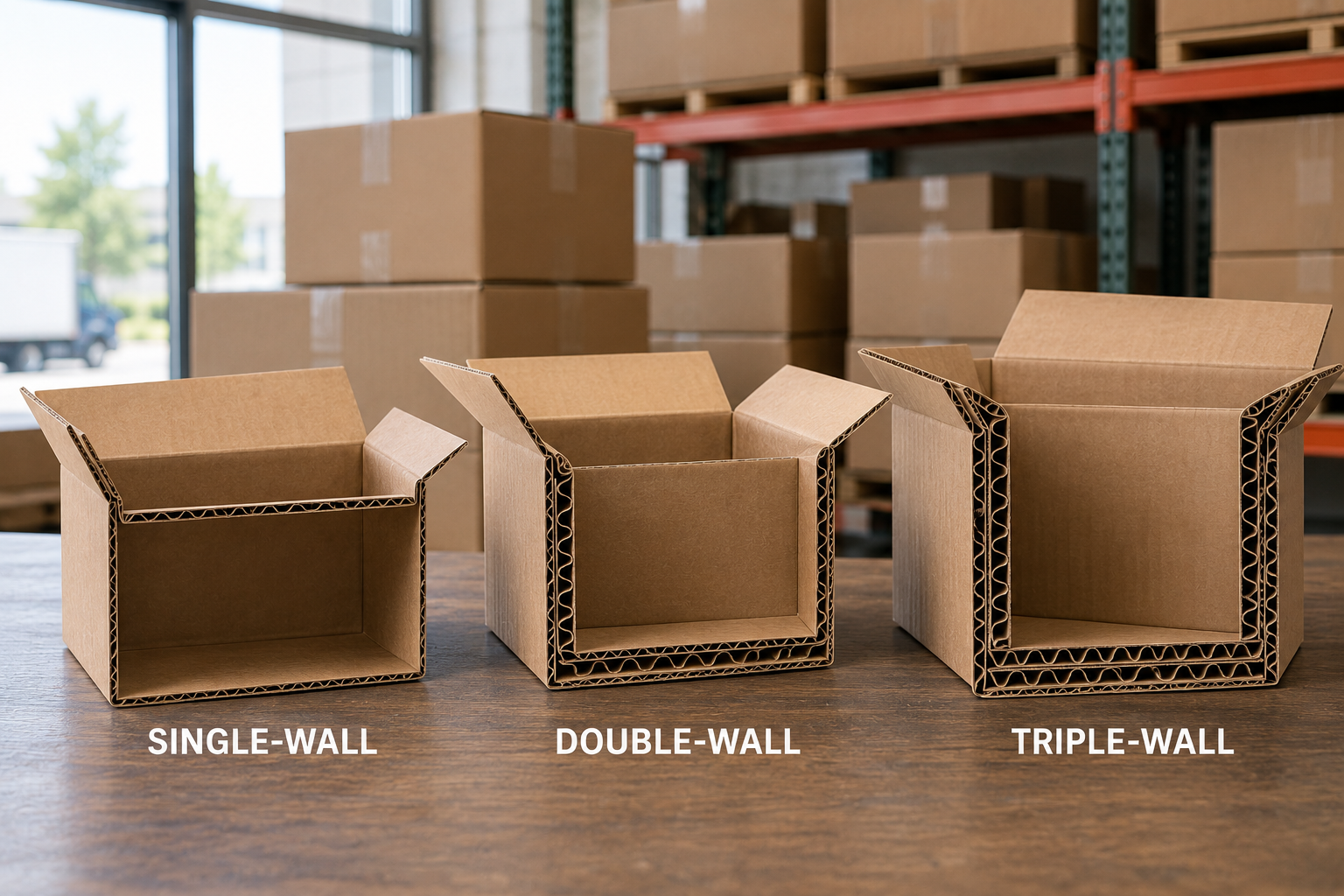
The difference between wall types is simple. The difference in knowing which one your operation actually needs is the difference between a well-spent dollar and one wasted.
What the wall types actually are
Single-wall corrugated has one layer of fluting (the wavy part) sandwiched between two layers of linerboard. It is 0.125 to 0.165 inches thick. A 32 ECT single-wall box is the standard.
Double-wall has two separate layers of fluting and three layers of linerboard, making it roughly twice as thick. It handles roughly four to five times the stacking weight of single-wall and resists puncture much better.
Triple-wall is even thicker and stronger, used almost only for specialty applications. Most GTA businesses never encounter it.
The cost difference is substantial. A double-wall box costs roughly 2.5 to 3.5 times what a comparable single-wall box costs. Triple-wall can run 4 to 6 times the cost. That difference makes sense only if you actually need the strength.
When single-wall is exactly right
Single-wall corrugated, 32 ECT, handles the majority of shipping, warehousing, and storage work in the GTA.
It is right for ecommerce shipments of consumer goods under about 40 lbs. Books, apparel, electronics, retail products, home goods: single-wall boxes these safely at standard tape and stretch wrap.
It is right for wholesalers and distributors moving boxes of moderate weight through normal supply chains. Case goods, food products (non-perishable), industrial supplies, office products.
It is right for retailers using boxes for retail shipping, point-of-sale display, and storage, where the box is not being beaten up in a distribution centre or stacked under heavy loads for months.
It is right for temporary storage, seasonal inventory, and anything that is not in a warehouse for longer than a few months or stacked more than six bundles high.
If you are buying 1,000 boxes a month and 95 percent of them move product safely, you are on the right specification. Do not change it.
When you need double-wall
Double-wall makes sense when single-wall starts failing for a specific use case, not when you are nervous about a general category.
Heavy items, over roughly 50-60 lbs per box, start creating problems for single-wall. At 65-70 lbs you are at the practical limit. At 80+ lbs, single-wall becomes risky if those boxes are stacked, stored for weeks, or handled multiple times.
Dense, concentrated loads. A box of nails or ball bearings weighs less than a box of cotton, but the density matters. The weight presses down on smaller dimensions and creates stress points. Single-wall handles it, but with less margin.
High-value or fragile items where a single damage claim, a return, or a customer complaint costs more than the box difference. Artwork, electronics components, high-end products. For these, double-wall is insurance, not overkill.
Long-haul or long-term storage. If a box is sitting in a warehouse for three months or travelling 2,000 miles through multiple carrier handoffs, double-wall protects better against humidity swings, rough handling, and stacking pressure.
Palletized loads stacked high. If you are stacking corrugated boxes ten high on a pallet for weeks, single-wall is marginal. Double-wall is the safer call.
Specific industries that have standardized on double-wall. Some automotive suppliers, high-value food producers, and pharmaceutical companies use double-wall as their standard because their supply chains and stacking practices demand it.
The key: upgrade for specific SKUs that are actually failing or at high risk, not for your entire range.
When triple-wall is actually needed
Triple-wall is used almost only for specialty applications in the GTA.
Very heavy loads, over about 150 lbs per box, when single or double-wall cannot handle the weight or when the box itself is the structural element of a palletized load.
Industrial equipment, machinery parts, concentrated metals and hardware moved as single heavy boxes rather than case goods.
Export shipments, where boxes are on pallets for weeks in containers and stacked under extreme conditions.
Reusable boxes, where triple-wall's strength means the box can be used 10-20 times before replacement, justifying the cost difference.
For 99 percent of GTA small and mid-sized businesses, triple-wall is not relevant. If you think you need it, call Packaging Shop and let us confirm. It usually turns out to be a double-wall situation or a better single-wall specification.
The cost trap: upgrading everything when you need to upgrade something
Here is where money gets quietly wasted.
A business ships mostly lightweight apparel in single-wall boxes and runs 5,000 boxes per month. One product line, heavy tools, fails sometimes in single-wall because it is at 65 lbs at the high end of the range. The temptation is to upgrade the whole operation to double-wall.
Cost: 4,000 extra boxes per month at, say, 50 cents more per box. 2,000 dollars a month. 24,000 dollars a year.
Better answer: keep single-wall for 4,500 boxes of apparel and other light goods, and buy 500 boxes per month of double-wall for the tools.
Cost: 250 extra dollars per month on the tool boxes. 3,000 dollars a year.
The difference is 21,000 dollars a year, for the exact same performance and safety.
Most businesses that say they upgraded to double-wall never ran the math. They did it once and did not go back. Do not be that business.
How to decide for your actual mix
Pull twenty recent shipments from your records, actual boxes you moved.
For each one, note the product category, actual weight, how many days it sat in a warehouse or on a pallet, and whether it arrived without damage.
Look for patterns. Do you see specific product types failing? Do certain SKUs consistently end up in multiple stacks or long-term storage? Do returns or complaints cluster around certain items?
Wherever you see a real pattern, that is your signal to explore a better box for that specific product. For most operations, you find maybe two to four SKUs that warrant a different spec.
For the rest, your current single-wall specification is probably right.
Your box specification checklist
For each product line or major SKU, decide:
What is the typical weight per box? Under 40 lbs, single-wall. 40-60 lbs, likely single-wall but edge case. 60+ lbs, check stacking and handling.
How long does the box sit in a warehouse? Days, single-wall is fine. Weeks to months, consider double-wall if weight or stacking is moderate.
How many times is the box handled or restacked? Handed over once from warehouse to customer, single-wall is adequate. Multiple carrier handoffs or internal restacking, more strength helps.
Is there a damage pattern? If a specific product consistently arrives damaged or the box fails under normal stacking, that SKU signals a need to upgrade.
Is the product high-value? If yes, double-wall is good insurance even if the weight and handling do not strictly demand it.
Most GTA businesses should run this exercise and find they are right where they are. A few find one or two lines that warrant a double-wall upgrade and nothing else.
What to do next
If you are already using single-wall for most of your range and are comfortable with the performance, do not change it.
If you see damage or failures clustering around specific items, pull those SKUs and ask about double-wall pricing. For many products, the upgrade is a few cents per box and makes sense.
If you do not know what you are using or why, call Packaging Shop. Bring a recent invoice, tell us what you ship and what you are seeing in terms of performance, and we will help you land on the right specification without over-specifying.