
What the mill actually needs
Recycling corrugated is a fibre recovery process. The box gets pulped in water, and the long kraft fibres are separated out and reformed into new liner and medium. Anything that survives pulping without breaking down is a contaminant.
That framing explains most of the rules:
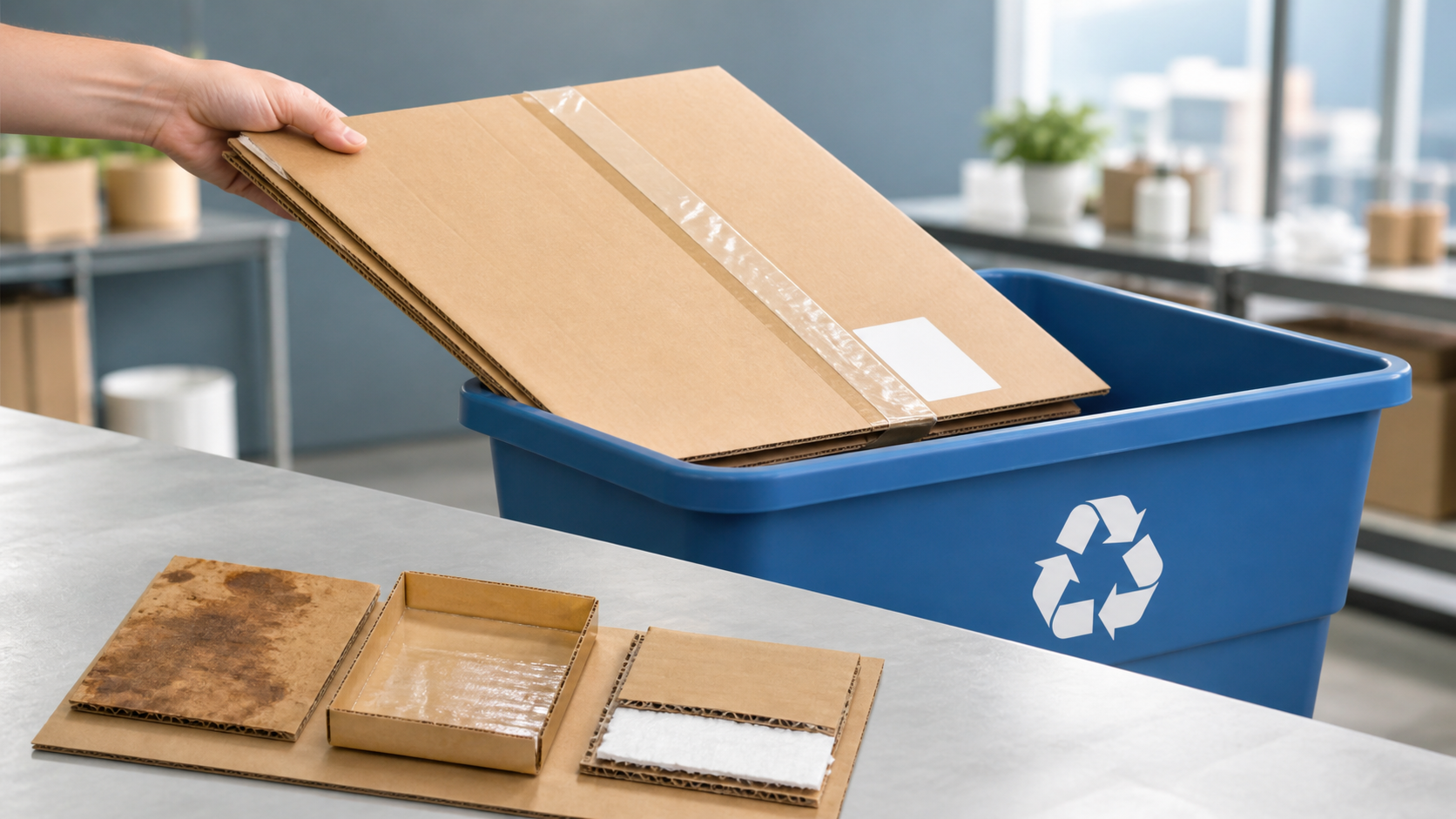
Paper tape and small plastic tape strips are fine, because the screening stage pulls plastic out and the volume is low relative to the fibre. You do not need to peel tape off before recycling.
Shipping labels are fine for the same reason. Removing them is wasted labour.
Staples and small metal are fine, because magnets pull them.
Grease and oil are not fine, because oil does not separate from fibre in water. A pizza-style grease stain genuinely ruins the fibre around it.
Wax coating is not fine. Waxed corrugated, still common in produce and cold chain, cannot be repulped in a standard mill and is rejected outright.
Plastic lamination and glued-on foam or film are not fine, because the plastic is bonded to the fibre rather than sitting loose on it.
The four things that actually get boxes rejected here
If you are a GTA business putting out volume, these are the realistic failure modes.
Wet or soaked board. Corrugated that has sat in rain loses fibre strength and, past a point, is treated as waste rather than feedstock. Store outbound recycling under cover, not in an open yard.
Waxed produce boxes mixed into the regular stream. If you receive goods in waxed cartons, those need to be separated. Mixed loads risk the whole bale.
Boxes with foam or film liners still inside. Insulated shippers and foam-lined cartons need the liner pulled before the board goes in.
Not flattening. This is a logistics problem rather than a fibre problem, but unflattened boxes fill a bin four times faster and drive up your hauling cost for no benefit.
Recycled content is not the same as recyclable
These two get used interchangeably in marketing copy and they mean different things.
Recyclable describes what happens after your customer is done with the box. Almost all plain corrugated qualifies.
Recycled content describes what the box was made from before you bought it. Most corrugated sold in Canada already contains a high proportion of recycled fibre, because the domestic supply chain runs on recovered material.
The practical implication for your marketing: claiming your boxes are recyclable is safe and true for plain corrugated. Claiming a specific recycled content percentage is a supplier-specific number, so ask for it rather than assuming, and do not publish a figure you cannot source.
Where recycled fibre changes how the box performs
This is the trade-off worth understanding before you optimize purely for recycled content.
Recycled fibre is shorter than virgin fibre because each recycling pass breaks it down further. Shorter fibre means slightly lower burst strength at the same board grade, more moisture sensitivity, and a dustier surface that adhesives grip less readily.
None of that makes recycled board a bad choice. It is the standard, and it performs well for the large majority of shipping. It does mean that if you are shipping heavy, stacking high, or storing in humid conditions, you should specify the board grade you need rather than assuming all board at a given wall type behaves identically.
Reducing packaging waste before you get to recycling
Recycling is the last step, and the cheapest waste is the material you never bought.
Reusing inbound cartons for outbound shipping is legitimate for internal transfers and for many B2B shipments. It looks unprofessional for consumer-facing ecommerce, so scope it deliberately rather than by accident.
Cutting a box down to fit is usually worse than buying the right size. A cut and re-taped carton loses much of its stacking strength because you have compromised the vertical flutes.
Buying fewer box sizes in larger quantities reduces per-unit cost, but pushes you toward oversized shipping and more filler. That trade-off is worth its own look at your actual order mix.
Kraft paper filler is easier for customers to dispose of than mixed plastic void fill, because it goes in the same bin as the box with no sorting decision.
What to tell your customers
If you want a line on your packing slip or site that is accurate for plain corrugated shipped with standard tape and labels, this works:
This box is curbside recyclable. Flatten it and put it in your blue bin. Tape and labels can stay on.
Do not use that line if your cartons are waxed, plastic-laminated, or foam-lined. In that case the accurate instruction is to separate the liner first, and to check local rules for the carton itself.
Quick checklist
Confirm your outbound cartons are plain corrugated, not waxed or plastic-laminated, before making any recyclability claim publicly.
Separate any inbound waxed produce cartons from your regular corrugated stream.
Store recycling under cover so board does not get soaked and downgraded.
Flatten everything, and make it a step in the receiving routine rather than a weekly cleanup.
Pull foam and film liners from insulated shippers before the board goes in the bin.
Ask your supplier for actual recycled content figures before publishing a percentage.
Specify board grade by what you ship, not by recycled content alone, especially for heavy or high-stack loads.
Stop cutting boxes down to size and price the correct size instead.
Packaging Shop stocks plain, curbside-recyclable corrugated in a wide size range, along with kraft paper filler, with same-day local delivery across the GTA, walk-in pickup at our North York location, and pickup-only at our Mississauga and Scarborough locations.