
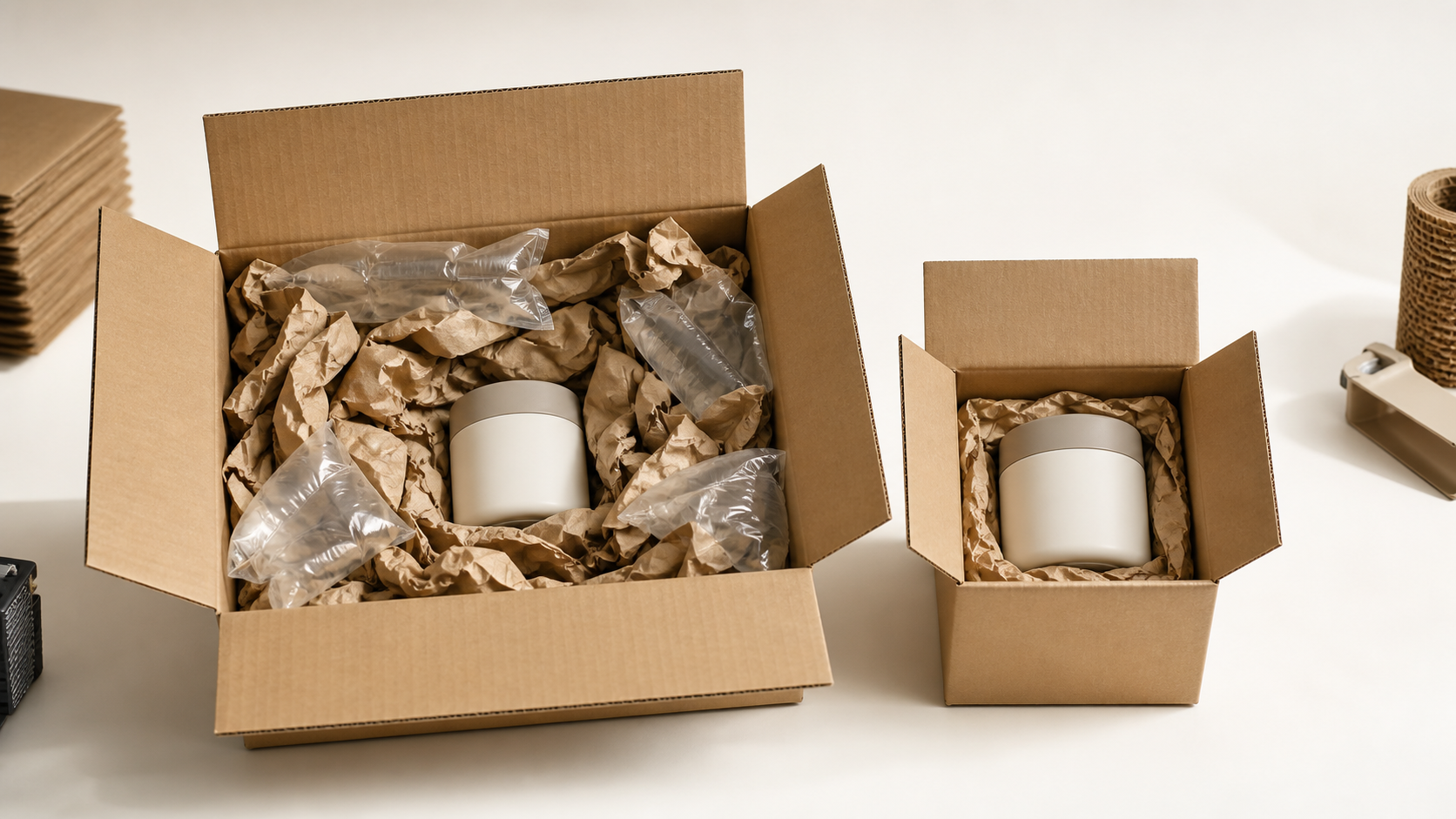
Why oversized boxes cost more than the box
Canadian carriers bill on dimensional weight, meaning you are charged on the greater of actual weight or the volume the parcel occupies. A light product in a box two sizes too big can be billed at double its real weight on every single shipment.
There are three separate costs stacking here:
The box itself is larger than it needs to be, so you pay more per carton.
The empty space has to be filled, so you pay for void fill and for the seconds it takes to pack it.
The carrier charges on the space, not the product, so you pay a shipping premium on every order for the life of that packaging decision.
The third cost is the one that compounds. A 40 cent packaging saving is nice. A recurring $2 dimensional weight penalty across 500 orders a month is a different conversation.
When right-sizing wins
Right-sizing means adding box sizes so your product fits closely without much filler.
It wins clearly when you ship a consistent, repeatable product mix. If 70 percent of your orders are the same three or four item combinations, there is almost certainly a box size that fits them properly.
It wins when your products are light and bulky, because that is exactly where dimensional weight bites hardest.
It wins when order volume is high enough that a small per-order saving becomes real money. At 300 orders a month, saving $1.50 per order is $5,400 a year.
The cost of right-sizing is inventory complexity. Every additional SKU means more storage space, more receiving, and more chance the packer grabs the wrong one. Most small operations should target five to eight box sizes, not twenty.
When void fill wins
Void fill wins when your order mix is genuinely unpredictable. Retailers and distributors shipping hundreds of different item combinations cannot right-size their way out of it, and chasing that is more expensive than filling the gaps.
It wins for fragile items, where the filler is doing structural work and not just occupying space. Cushioning is not void fill's consolation prize, it is the actual job.
It wins at low volume, where the storage cost and minimum order quantities of extra box sizes outweigh the per-shipment saving.
Choosing a void fill material
Not all filler is doing the same job, and the cheapest per cubic foot is often not cheapest per shipment.
Kraft paper is the general-purpose choice. It is recyclable curbside, it blocks and braces well when crumpled properly, and customers do not have to think about how to dispose of it. It takes up more storage space than the alternatives.
Air pillows are the cheapest per cubic foot of fill and take almost no storage space before inflation, but they cushion poorly. They are space fillers, not shock absorbers. Use them for durable goods, not for anything that would break if the box were dropped.
Bubble is a wrap material, not a void fill. Wrapping the item and then filling the remaining space with paper is usually better and cheaper than trying to fill an entire cavity with bubble.
Foam and moulded inserts make sense only for high-value or genuinely fragile products where a single damage claim exceeds the packaging cost difference many times over.
Run the math on your own orders
You do not need a consultant for this. Pull twenty recent shipments and check three things.
Measure the actual product footprint versus the box interior. If there is more than about two inches of slack on any dimension, that box is oversized for that order.
Add up what you are spending per order on filler, including the time to apply it. Ten seconds of packing labour per order is real at volume.
Compare the billed weight on the carrier invoice against the actual weight. Wherever billed weight is meaningfully higher, you are paying a dimensional weight penalty that a better-fitting box would remove.
If the same one or two product combinations keep showing up on that list, you have found your right-sizing opportunity. Order that size, and keep the void fill for everything else.
The hybrid approach most GTA businesses should run
In practice the answer is rarely one or the other.
Right-size your top movers. Identify the handful of order profiles that make up most of your volume and buy boxes that fit them.
Keep a small range of general-purpose sizes for the long tail, and use kraft paper to fill and brace those.
Reserve heavier cushioning for the specific SKUs that actually break, rather than treating every order as fragile.
Revisit the mix twice a year. Product lines change, and a box range that fit perfectly two seasons ago drifts out of alignment quietly.
Quick checklist
Pull twenty recent orders and measure product footprint against box interior.
Flag any shipment with more than two inches of slack on a dimension.
Compare billed weight to actual weight on your carrier invoices to find dimensional weight penalties.
Identify the top three to five repeating order profiles and price a box size that fits each one.
Cap your total box range at roughly five to eight sizes unless volume clearly justifies more.
Choose void fill by job, paper for general bracing, air pillows for durable goods, proper cushioning only where damage risk is real.
Recheck the mix every six months.
Packaging Shop stocks corrugated boxes in a wide size range along with kraft paper and other void fill, with same-day local delivery across the GTA, walk-in pickup at our North York location, and pickup-only at our Mississauga and Scarborough locations. Bring your product dimensions and we will help you narrow the size range.