
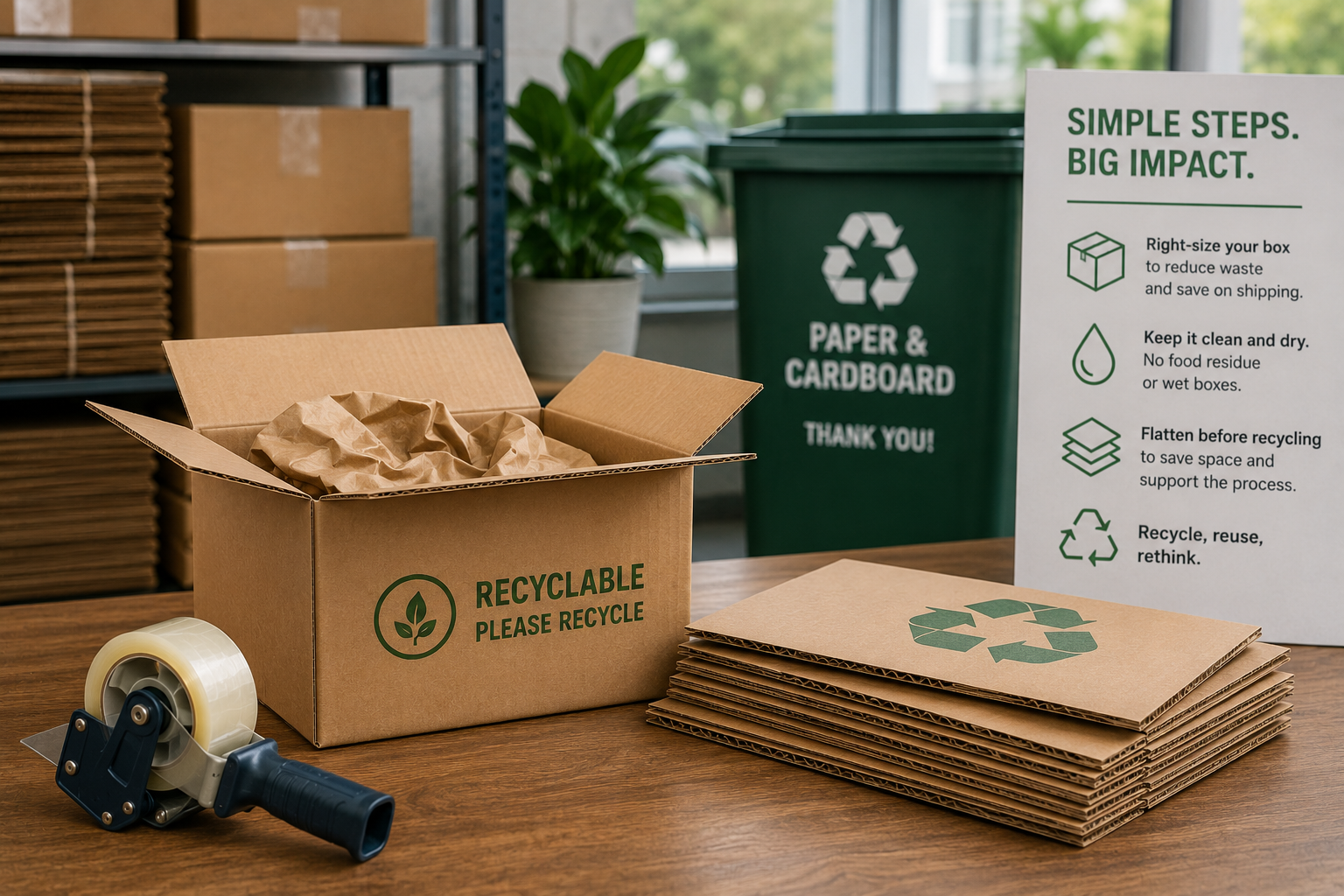
What makes corrugated recyclable in the first place
Corrugated is paper fibre: a fluted inner layer glued between two liners. Those fibres can be pulped and reformed several times before they get too short to use, which is why most boxes on the market already contain a high share of recycled content. That also means the box you ship today is likely to become the box someone ships next year, provided it enters the stream in usable condition.
Two things ruin that: contamination and moisture. Wet corrugated loses fibre strength and is often rejected, and food residue, wax coatings, and heavy plastic contamination pull a load out of the paper stream.
What goes in, what doesn't
Goes in the cardboard stream:
- Plain corrugated boxes, flattened
- Boxes with normal amounts of paper or plastic packing tape still attached, most GTA facilities screen tape out during pulping
- Kraft paper void fill and paper-based cushioning
- Printed boxes, standard inks are not a problem
Keep out:
- Wax-coated or heavily laminated boxes, these are not paper-recyclable
- Wet, oily, or food-soiled corrugated
- Plastic film, bubble wrap, and foam peanuts, these need a separate film drop-off, not the paper stream
- Stretch wrap, which is LDPE film, it never belongs in the cardboard bin
The practical takeaway: the more single-material your outbound packaging is, the higher the odds it actually gets recycled rather than pulled out at the sort line.
Where stretch wrap and tape fit
Stretch wrap is recyclable in principle as LDPE film, but not through curbside or standard commercial paper collection. If you palletize regularly, the realistic option is baling your used film and taking it to a film recycler or a retail film drop-off, which only makes sense at volume. Below that volume, the more useful goal is using less film per pallet by wrapping with proper tension rather than adding passes.
Tape is a smaller factor than most people assume. Standard packing tape at normal coverage is screened out during pulping. Over-taping a box in a lattice pattern is worse for recyclability than one clean H-tape seal, and it costs more, so the cheaper habit is also the better one here.
Cutting waste is usually the same move as cutting cost
The most sustainable box is the one you didn't need to upsize. Right-sizing has the same effect on both sides of the ledger:
- Less fibre per shipment, which is less material bought and less material to dispose of.
- Less void fill, because a properly sized box doesn't need to be packed out with filler.
- Lower dimensional weight, which is what most couriers bill on, so smaller boxes cost less to ship as well as less to buy.
If you want one measurable sustainability metric to track, track average void volume per shipment rather than recycled content percentage. It's the one you actually control week to week.
Reuse before recycling, where it makes sense
Recycling is the third option, not the first. Two habits worth building into a GTA operation:
- Keep clean inbound boxes that match your outbound sizes and reuse them for internal transfers, storage, or non-customer-facing shipments.
- Flatten and store rather than crushing. Boxes that get stepped on lose their edge crush strength and stop being reusable, which turns a reusable asset into recycling volume.
For customer-facing shipments most businesses want a new, branded-looking box, and that's fair. Reuse still covers a real share of internal and B2B volume.
Telling your customers, without overclaiming
If sustainability is part of how you sell, keep the claim narrow and true. "Ships in recyclable corrugated, please flatten before recycling" is accurate and useful. Broad claims like "100% sustainable packaging" invite scrutiny and are hard to substantiate, especially if there's plastic film or foam inside the box.
A short line printed on the box or on the packing slip telling the recipient to flatten it also measurably improves the odds it's recycled properly, which is a cheap win.
Your corrugated sustainability checklist
1. Keep it clean and dry, wet or food-soiled corrugated is not recyclable
2. Flatten every box, before recycling and before storing for reuse
3. Separate the streams, corrugated to paper, stretch wrap and bubble to film, never mixed
4. Skip wax-coated and heavily laminated boxes if recyclability matters to you
5. Tape normally, one clean H-tape seal rather than over-taping
6. Right-size first, less box means less waste, less filler, and lower dimensional weight
7. Reuse inbound boxes for internal and non-customer-facing shipments
8. Keep your customer-facing claims specific and true