
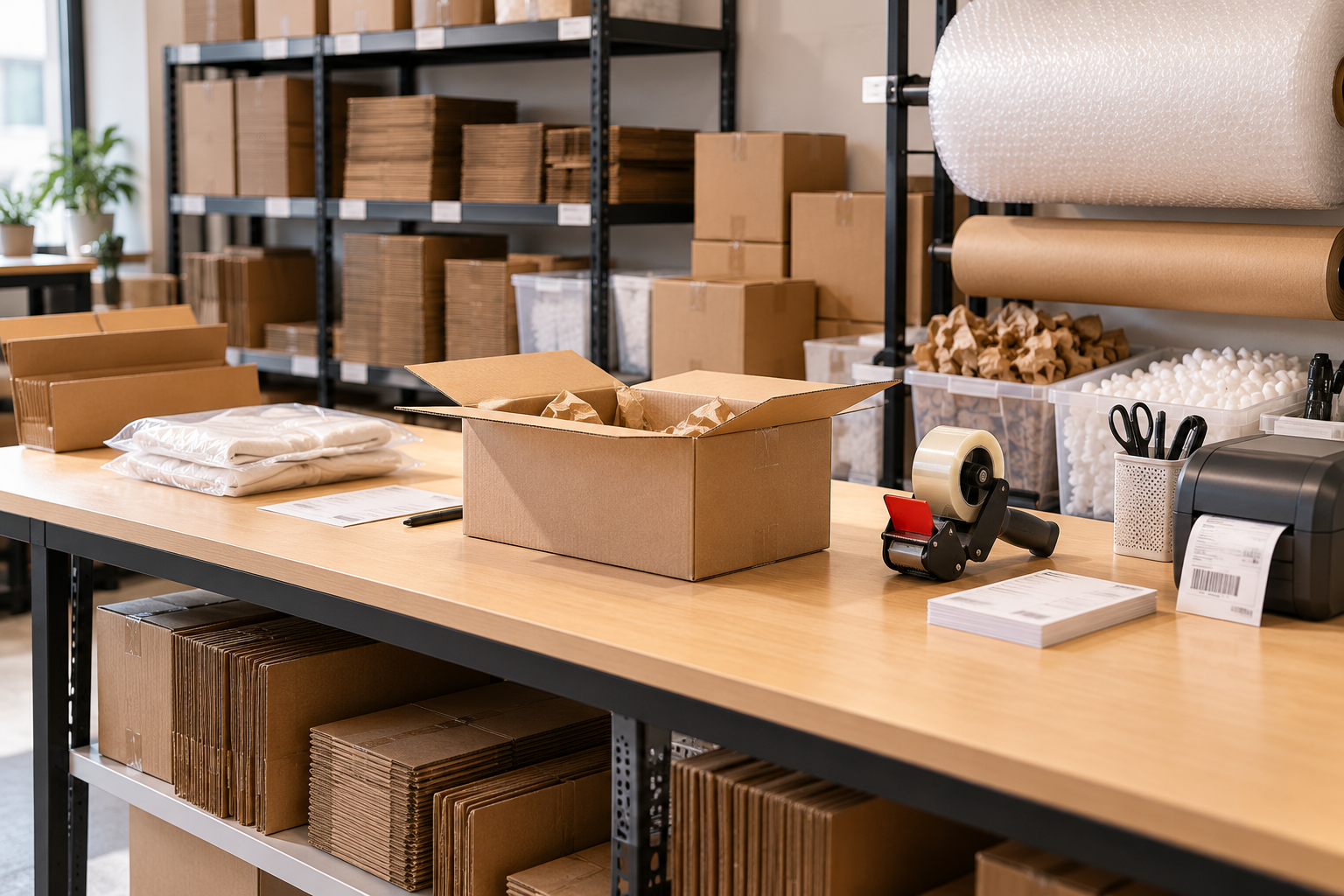
A packing station is not just a table with supplies on it. It is a small production line, and like any production line, the layout decides how fast and how accurately work gets done. Fixing it is usually a half-day project with an immediate payoff.
The real cost of a bad layout
The cost of an inefficient packing station rarely shows up as one obvious problem. It shows up as small delays that repeat all day: walking to a shelf for the right box size, digging through a bin for the right tape, re-packing an order because the wrong box was grabbed, or double-handling product because there is no clear surface to stage it.
Multiply a 15 to 30 second delay by 100 or 200 orders a day, and the packing station is quietly costing an hour or more of labour daily, on top of the higher error rate that comes with a cluttered or poorly lit workspace.
The core layout: work should move in one direction
The single most useful principle for a packing station is that product should flow in one direction, from receiving the pick, to boxing, to sealing, to labelling, to the outbound stack. If a packer has to walk backward or cross their own path to finish an order, the layout is fighting the work.
A simple version of this for a small operation: staging area on the left where picked items land, box selection and packing in the middle, sealing and labelling on the right, with a clear outbound zone past that. Even a single folding table can follow this logic if supplies are arranged along it in that order rather than scattered.
Box sizing: the single biggest efficiency lever
More packing time is lost hunting for the right box size than almost any other single cause. If your box range is not organized by size, in a labelled shelf or bin system, sorted smallest to largest or by product category, every order takes longer than it needs to.
Standardize on the smallest number of box sizes that actually cover your product range. Fewer sizes means faster selection, less wasted void fill, and simpler reordering. Most GTA small businesses can run their entire catalogue on four to six box sizes once they actually map it out, even if history has left them holding a dozen odd sizes ordered one at a time.
Keep your two or three highest-volume sizes within arm's reach of the packer, and lower-volume sizes one step further away. This alone removes a meaningful amount of walking from a busy day.
Tape, fill, and small supplies: fixed positions, not floating bins
Tape guns, packing tape rolls, void fill, labels, and scissors should each have one fixed location that never changes, ideally mounted or held in place rather than sitting loose. A tape gun that lives in a different spot every day costs a packer several seconds every single time they reach for it, and seconds compound across hundreds of orders.
A wall-mounted tape gun holder, a dispenser for void fill, and a dedicated label printer stand are inexpensive and pay for themselves within weeks for any operation doing meaningful daily volume.
Bench height and surface space matter more than they get credit for
A table that is too low forces packers to hunch over boxes all day, which slows movement and causes fatigue-driven mistakes by the afternoon. A standard packing bench height of roughly 34 to 38 inches suits most adults standing to pack. If multiple people share a station across shifts, an adjustable-height bench removes the need to compromise for one person's comfort at the expense of another's.
Surface space is just as important as height. A packer needs room to have the shipping box, the item being packed, and any inserts or paperwork open at the same time without stacking things on top of each other. A table that is too small forces constant shuffling, which is where damaged product and mis-packed orders happen.
Labelling and outbound: don't let it become a bottleneck
If label printing is slow, physically far from the packing bench, or shared with another task like receiving, it becomes the choke point no matter how efficient the rest of the station is. A dedicated label printer at the packing station, even a basic one, removes a surprising amount of daily friction compared to printing at a shared office computer across the room.
The outbound staging area should be large enough to hold a full day's shipments without spilling into walking paths. If courier pickup is once a day, this space needs to handle your peak daily volume, not your average.
A packing station checklist
- Map your actual product range and standardize on four to six box sizes instead of whatever has accumulated over time
- Arrange the station so work flows in one direction: staging, packing, sealing, labelling, outbound
- Give tape, fill, and small supplies fixed, dedicated positions within reach of the packer
- Set bench height around 34 to 38 inches, or use an adjustable bench for shared shifts
- Keep your highest-volume box sizes closest to the packer, lower-volume sizes further away
- Give labelling its own dedicated printer at the station, not a shared office computer
- Size the outbound staging area for your peak day, not your average day