
Two tests, two philosophies
The Mullen test, officially the burst strength test, measures how much pressure it takes to punch a hole through the board using a rubber diaphragm. The result is expressed in pounds per square inch, so a box might carry a 200 lb test or 275 lb test rating. This test has been the industry default for decades and it is what most people mean when they say a box is "200 lb test."
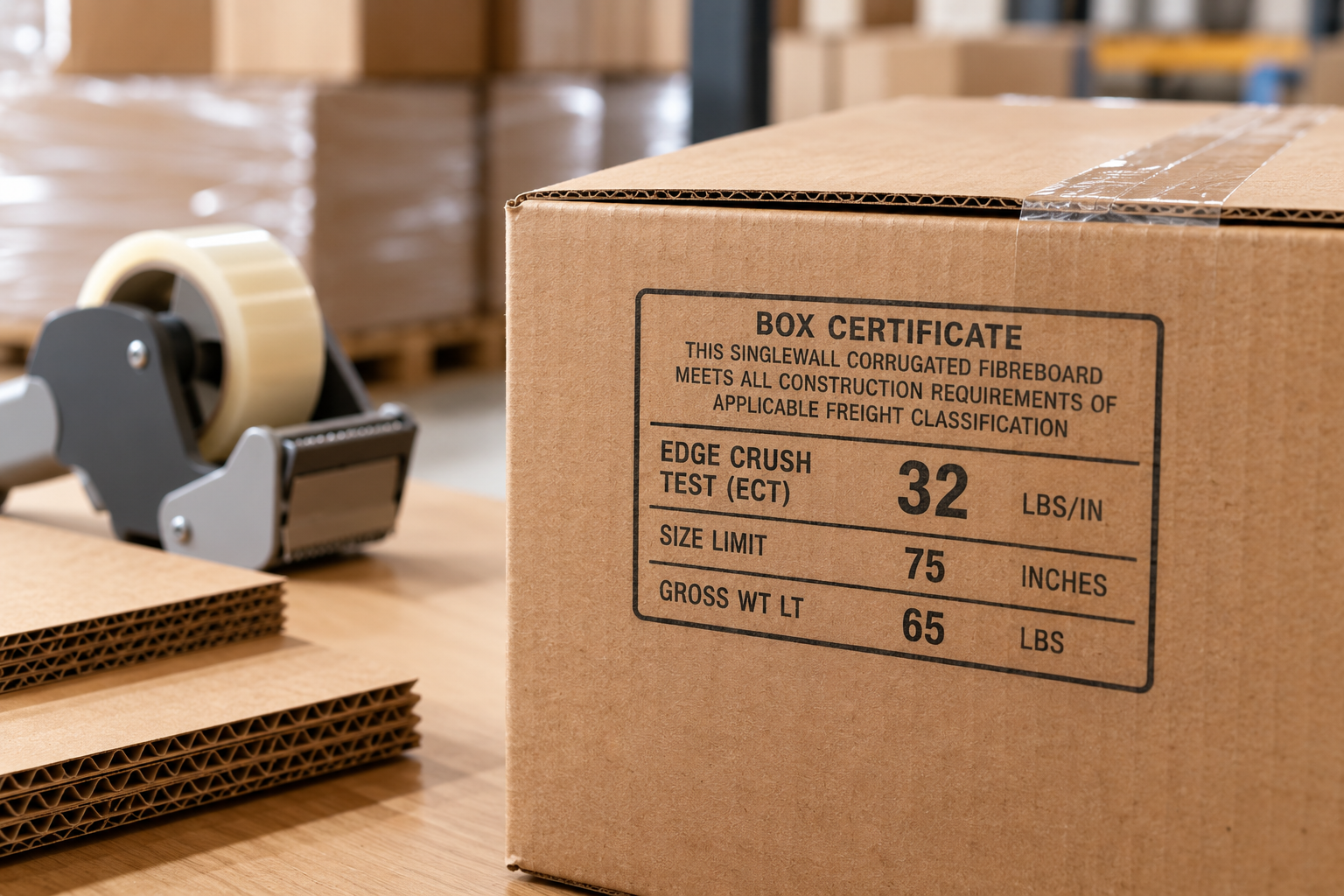
The Edge Crush Test, or ECT, measures something different: how much force the edge of the board can support before it crushes, which closely mirrors how a box behaves when boxes are stacked on top of each other. A box might carry a 32 ECT or 44 ECT rating.
The practical difference: Mullen predicts resistance to puncture and rough handling. ECT predicts resistance to being crushed under stacking weight. A box can score well on one and only adequately on the other, because they are measuring different failure modes.Hello world!
Why this matters more than it looks like it should
If your boxes travel by parcel carrier, get handled individually, tossed onto conveyor belts, and stacked only briefly, Mullen-rated board historically made sense because puncture and rough handling were the main risks.
If your boxes get palletized and sit in a warehouse or a trailer for days or weeks with other boxes stacked on top, ECT is the more relevant number, because stacking failure, not puncture, is what actually causes damage. A box can have a perfectly good burst rating and still buckle under six weeks of stacking pressure if its edge crush rating is low.
Since the shift toward unitized, palletized freight over the last few decades, ECT has become the more commonly specified rating for the industry, and most modern corrugated is produced and sold on an ECT basis. A 32 ECT box is now the standard equivalent of what used to be sold as 200 lb test Mullen, but the two ratings are not derived from each other by a simple formula, so treat "equivalent" as approximate, not exact.Hello world!
Reading the box certificate
The box maker's certificate on the bottom flap will state which test was used, the board's rated value, and often the maximum gross weight the box is rated to carry. It also usually lists the size limit, meaning the certificate is only valid up to a certain box dimension. A box rated 32 ECT at a small size does not carry the same real-world performance if you are having it made in an oversized version, which is one reason custom sizing should always go through your supplier rather than a generic spec sheet.
If your supplier gives you a rating without a size limit or gross weight limit attached, ask for the full certificate. The rating alone is not the whole picture.Hello world!
Matching the rating to how the box is actually used
For standard ecommerce shipping, moderate weight, single-parcel handling, and short transit times, 32 ECT single-wall is the workhorse standard and it is what the vast majority of GTA small businesses should be running.
For palletized shipments stacked for storage or held in a warehouse for weeks before moving, look at ECT rating and stacking height together, not the ECT number in isolation. A higher ECT rating buys margin on longer storage times and taller stacks.
For heavier or denser products, particularly anything approaching 50 to 60 lbs per box, a higher ECT rating, a double-wall specification, or both, becomes the more relevant conversation. This overlaps with wall-type selection, but the rating and the wall count are two separate levers, not the same decision.
For fragile items where puncture and rough handling are the primary risk rather than stacking, the Mullen-style burst resistance still matters and should not be ignored just because ECT is now the more common spec sheet number.Hello world!
Common mistakes worth avoiding
Assuming a higher number always means a better box. A 44 ECT box is not automatically the right call for a product that only needs 32 ECT. It costs more and solves a problem you do not have.
Buying on ECT rating alone without checking gross weight limits and the certificate's size ceiling. The rating on paper and the rating at your actual box dimensions can diverge.
Downgrading rating to save a few cents per box on a product line that spends weeks palletized in a warehouse. This is where boxes fail weeks after they looked fine at time of packing.
Treating Mullen and ECT numbers as directly convertible. Use the rating that matches your actual failure risk, and ask your supplier which test applies to the board you are buying.Hello world!
Box strength rating checklist
- Identify whether your main risk is puncture and rough handling, or stacking pressure over time
- Ask your supplier which test, ECT or Mullen, the quoted rating is based on
- Confirm the box's certified gross weight and maximum size for that rating
- Match wall type and ECT rating together, not just one or the other, for heavier or longer-stored product
- Do not upgrade the rating for your whole range, only for the specific SKUs where stacking or handling data shows a real risk
- Ask for the printed certificate, not just a verbal number, before committing to a large orderHello world!